HLTH 2025: Innovation Becomes Personal, Practical, and Purpose-Driven
The HLTH USA 2025 conference in Las Vegas had all the usual hallmarks of a can’t-miss industry event: packed sessions, endless demos, crushed step goals, and maybe one too many lattes. Yet this year’s vibe felt different. Despite the excitement, the hype had a restrained quality, the buzzwords were fewer, and the substance was stronger. Across every corner of the show floor, the message was clear: digital health and health-tech are growing up.
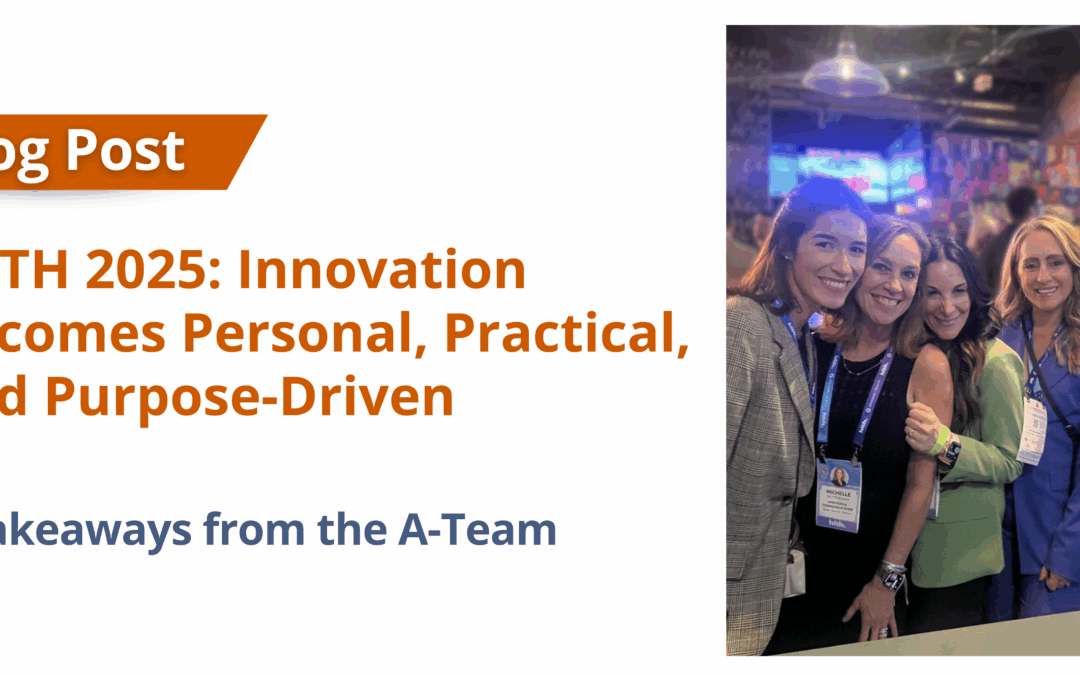
Of course, the A-Team was on the ground at the Venetian Expo Center helping clients share their stories and soaking in what’s next for health tech. Although the companies and perspectives at HLTH this year were as diverse as usual, our experienced PR and marketing professionals observed some differences: AI has moved from novelty to necessity; investment in women’s health, disease prevention, and patient partnership is reaching new heights; and overall, solutions are reaching new levels of personalization. In greater detail, here are their biggest takeaways.
AI Finds Its Footing in the Real World
According to Jodi Amendola, President and Founder of Amendola Communications, “Companies that brought outcomes and ROI to life with customer and patient stories were the ones resonating most. Companies that effectively communicated how their innovation is delivering real-world impact really stood out.”
Jodi also reflected on what makes HLTH such a special event. “What struck me most was the sheer enthusiasm across the digital health community. These are passionate, like-minded people who truly want to improve healthcare. Conversations around AI, the changing market, and new legislation were everywhere. I left grateful for the connections, collaboration, and energy that continue to push this industry forward.”
Evolving from Buzzword to Backbone
While AI still dominated nearly every booth and session, the conversations this year focused less on what it might do and more on what it is doing right now.
“AI is no longer a differentiator; it’s a given,” said Michelle Noteboom, Senior Account Director. “Nearly every company had an AI angle, whether in the form of applications, platforms, or tools designed to automate time-consuming or tedious aspects of healthcare workflows.”
But with expansion comes new challenges, Michelle noted. “As AI generates huge amounts of new data, the focus appears to be shifting toward data quality, interoperability, and ethical monetization,” she added. “How can organizations ensure that data is clean, usable, and privacy-preserving? Those questions dominated the conversations.”
Another new trend Michelle observed was the rise of “agentic AI,” the term for autonomous agents built for specific healthcare tasks such as prior authorizations, referrals, and claims management. “It is clear that many solutions and healthcare organizations represented at HLTH have far transcended pilot projects and are well into practical deployments,” she said. “The AI that reduces administrative friction and enhances care delivery is a clear early winner.”
Industry Lines Blur
Beyond AI, the HLTH show floor revealed another major trend: healthcare’s growing convergence across traditional boundaries.
As Grace Vinton, Account Director and Media Specialist, observed, “Innovations that once targeted specific verticals are crossing over. Solutions built for health systems are gaining traction with pharma, while employers are adopting payer tools. There’s a growing spirit of collaboration across sectors, all aimed at strengthening margins, improving data access, and driving sustainable transformation.”
Grace also predicted a wave of consolidation in the coming year. “There are so many point solutions proving real, measurable impact,” she said. “It feels like we’re on the verge of major M&A activity as these niche players find their homes in larger ecosystems.”
That spirit of collaboration extended beyond vendors and investors to include patients themselves, whose voices are increasingly central to healthcare innovation.
“One of my favorite parts of HLTH25 was the ‘Ask Patients’ Genius Bar,” Grace added. “Seeing patients and caregivers recognized as lived-experience experts is the future of healthcare innovation. It’s no longer enough for technologists to guess what people want. Patients and caregivers are stepping into paid, official roles in research and product design, which is long overdue.”
Human-Centered Innovation
The renewed focus on patient experience mirrored the industry’s shift toward more personalized and preventive care.
“As a first-time HLTH attendee, it was exciting to see how innovation is becoming more human-centered,” said Maddie Noteboom, Senior Account and Social Media Manager. “AI, automation, and analytics are working quietly in the background to help clinicians make better decisions and give patients a smoother, more personalized care experience. The companies making real progress are the ones using technology to handle the busywork so care teams can focus on patients and help them achieve better outcomes and health goals.”
Katlyn Nesvold, Senior Account Director, agreed that the tone at HLTH25 reflected more profound empathy and purpose. “There was so much emotion in the conversations,” she said. “It is a sign of the times and an indicator that this is important work we are doing. We all need to come together to improve healthcare access, and hopefully AI’s rapid development will help.”
Alongside this more human approach, HLTH 2025 also spotlighted several fast-growing areas of innovation and investment beyond AI.
Grace noted that “Women’s health took center stage, with major funding announcements and a surge of new market entrants. It’s one of the most untapped opportunities in healthcare innovation, and momentum is building fast.”
Katlyn added that weight management was another major topic of conversation. “Yes, GLP-1s were everywhere,” she said, “but many vendors are now offering holistic alternatives, such as digital health tools, remote coaching, and preventive programs, to help people manage their health without relying solely on medication.”
A Tight-Knit Community
Amid all the innovation and buzz, HLTH 2025 also reminded attendees of the value of connection and community in the health IT world.
“The health IT community is like no other,” Katlyn shared. “It is full of great people doing meaningful work. The best conversations often happen outside the show floor, such as at dinners, meetups, and chance encounters between sessions, where collaboration begins.”
Michelle agreed, pointing to Amendola’s own whirlwind of activity. “We were thrilled to help facilitate over 100 media meetings in just three days,” she said. “The level of engagement and curiosity was incredible, but it also shows how hungry the market is to understand where healthcare innovation is really headed.”
Looking Ahead
If HLTH 2025 made anything clear, it is that the industry has moved from inspiration to implementation. AI is no longer a novelty; it is an expectation. Patients are no longer passive participants; they are partners. And despite the flash and fanfare associated with such a major industry event, this year’s HLTH demonstrated that health tech and digital health success is not about who shouts the loudest, but rather who delivers meaningful, measurable outcomes.
At Amendola Communications, those are the stories we are proud to help tell.